Flipas – Urban Culture Lab
Flipas is a laboratory for urban cultures that connects artists, institutions, and communities through residencies, workshops, and public presentations. Its mission promotes exchange across disciplines and cultural contexts, and recognizes communities as active participants in cultural production. Cultura UC3M has been collaborating with the project for several editions, linking its international dimension with the university community and local collectives.
Under the artistic direction of Mateo Feijóo, Flipas brings together music, sound art, theater, performance, dance, audiovisual creation, and urban art at various venues in Madrid and its suburbs.
This festival is organized by the Goethe-Institut and the Alliance Française. It is supported
Flipas 2026
Its ninth edition, Flipas 2026, features 19 artists from eight countries and builds on a network of collaboration that fosters experimentation, shared learning, and access to contemporary art.
Cultura UC3M’s contribution to this edition includes a workshop on theatrical creation developed in collaboration with the THEAOMAI theater group at the IES Julio Verne high school in Leganés, as well as the organization—in collaboration with partner organizations—of two audiovisual events on the Madrid-Puerta de Toledo campus.
The workshop, held on October 16, was part of “La Tierra de Nadie”, a project by Cristina Messnik, featuring musical accompaniment by Kamil Urbánski on guitar and Adrian Gaspar on piano. The project grew out of an interdisciplinary piece originally developed with young people from the Romani community and involved a process of collective creation through the body, the voice, and music. Featuring Papusza’s poetry as a reference, the content explored identity, memory, belonging, and the value of shared space. The project was funded by the embassies and cultural centers of Austria, Romania, and Poland.
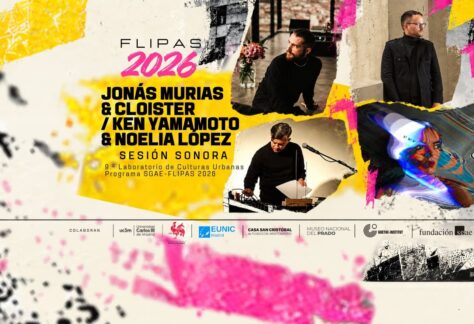
UC3M’s participation also includes the sound session and audiovisual performance by “Muriel and Noelia López”, a project that combines improvised electronic music with real-time-generated images. The soundscapes created with synthesizers and samplers interact with visuals that react to the sound through “live coding” techniques. The event is part of the SGAE-Flipas 2026 Program and is organized in collaboration with the Goethe-Institut, the Prado Museum, and the SGAE Foundation.
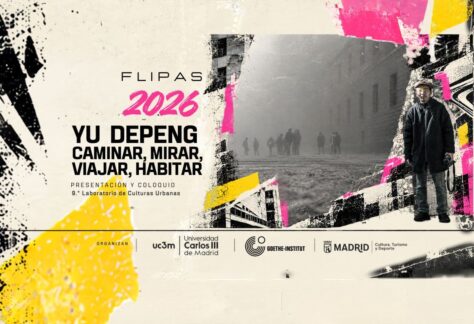
In addition, Cultura UC3M is collaborating on the presentation and discussion of “Walking, Looking, Traveling, Living,” by the Madrid-based Chinese video artist and filmmaker “Yu Depeng”. The project explores Madrid’s urban and social landscape through public spaces, domestic environments, and intergenerational experiences, inviting reflection on memory, care, and relationships with the local area. This collaboration, which involves the Goethe-Institut and the Madrid City Council’s Department of Culture, Tourism, and Sports, links the university event with the video installation presented at the Goethe-Institut’s headquarters.
Concerts at the Prado National Museum
The SGAE-Flipas 2026 Program brings together three sessions at the Prado National Museum that explore different approaches to sound creation, electronic music, and audiovisual experimentation. Cultura UC3M is collaborating on this series, which fosters encounters between artists from diverse backgrounds and their audiences.
On October 9, José Venditti and Marta Verde presented “GAMMA A/V,” a performance that combined sound, light, and imagery to artistically explore the transition and changes of state associated with the end of life. The performance kicked off the series’ program at the museum.
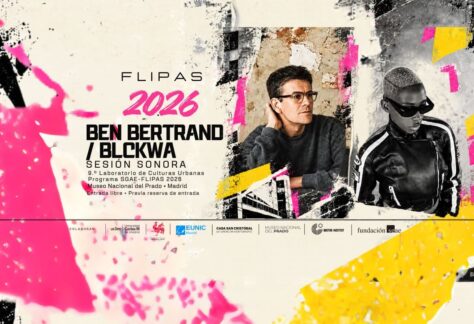
The session by Ben Bertrand and Blckwa brings together two complementary approaches to sound. The Belgian clarinetist and composer presents “Relic Radiation,” a work that blends the clarinet and electronics with ancestral musical references. Blckwa offers a selection rooted in kuduro, batida, Afro house, and underground sounds, with a special focus on rhythm and connecting with the audience.
Meanwhile, Jonás Murias and Cloister / Ken Yamamoto and Noelia López present two works that explore the relationship between words, memory, and sound experimentation. “nstrç no prtremç,” by Jonás Murias and Cloister, interweaves Aljamiado texts, processed voices, and Iberian folk music to address cultural dispossession and Moorish memory. “El pan de todos. A Sound Essay for a Common Voice,” by Ken Yamamoto and Noelia López, combines poetry, fragments, and layers of sound in a reflection on shared resistance and the construction of a common voice.
The events in this series are free and require advance registration through the Prado Museum. The Goethe-Institut, the SGAE Foundation, the Prado Museum, Casa San Cristóbal of the Montemadrid Foundation, EUNIC Madrid, the Wallonia-Brussels General Delegation in Spain, and Carlos III University of Madrid are collaborating on these events.
International Cooperation and History
Flipas was founded in 2017 through a collaboration between Naves Matadero, the Goethe-Institut Madrid, and the Alliance Française, as part of the Franco-German Cultural Fund. For its 2026 edition, the network of participating and collaborating organizations includes the Goethe-Institut, EUNIC Madrid, the SGAE Foundation, Kheiron, the Alliance Française, the Wallonia-Brussels General Delegation in Spain, the Romanian Cultural Institute, the Polish Institute of Culture, Austrian Cultural Forum, Embassy of the Netherlands, Czech Center, Prado National Museum, La Casa Encendida, Casa San Cristóbal of the Montemadrid Foundation, Dejóvenes de Leganés, Carlos III University of Madrid, Africa Moment, Réplika Teatro, Solidarios, and the Madrid City Council.
Cultura UC3M’s involvement in Flipas has included community embroidery with Stephan Goldrajch, urban interventions by LOR-K, mural painting by the Happy My Atelier collective, and textile upcycling workshops led by Alina Gurguţă, Maëva Weissen, and Léonie Olmos. These experiences share a vision of culture as a space for gathering and collective creation, which strengthens the ties between the university and its surrounding community.
upcoming events
past events
other editions
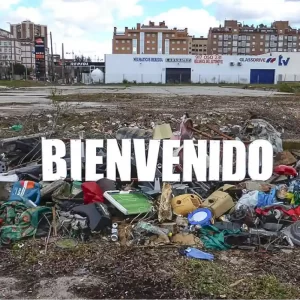
urban installation on waste
Artist: LOR-K (France) creates ephemeral sculptures in the street, making it the central focus of his research. Through a series of experiments, he carries out a series of urban actions, which he documents through photography and video.
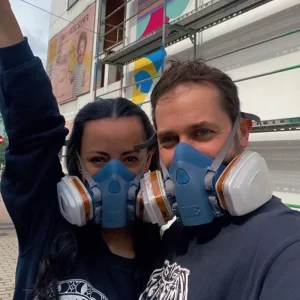
Mural at the Drug Addiction Treatment Center.
Artists: Sara Sierra Rivera (Colombia). With a bachelor’s degree in Advertising and Graphic Design, she pursued graduate studies at the University of Salamanca in Spain. She has been actively involved in the advertising industry, positioning new brands in the market and launching her own startup. Paweł Ziemicki (Poland) is a law school graduate, an optimist, and an art enthusiast who combines a passion for learning about and understanding new cultures with a desire to communicate through visual language. Together, they form the collective “Happy My Atelier.”
Fashion and Recycling Workshop with Alina Gurguţă (Romania)
Artist: Alina Gurguta (Romania) graduated from the Faculty of Decorative Arts and Design at the National University of Arts in Bucharest and completed her master’s degree in Fashion and Costume Strategies and her Ph.D. in Visual Arts at the same university. Fashion designer, fashion stylist, and set designer. She currently serves as a Ph.D. professor at the National University of Arts in Bucharest in the Department of Fashion Design.
Textile Recycling Loom Workshop with Maeva Weissen (Switzerland)
Artist: Maëva Weissen (Switzerland) was born in Geneva. She grew up in the working-class neighborhood of Onex Cité. She earned a degree in Fashion Design from the Haute École d’Art et de Design in Geneva and holds a Master’s degree in Contemporary Craft from Konstfack University in Stockholm. Her work is rooted in what she identifies as the “third culture”—that of young people in Swiss working-class neighborhoods who come from different diasporas. Weissen explores the aesthetic and cultural references that influence this working-class culture, whether they are linked to music, fashion, soccer, or the various forms of folklore that comprise it. As a multidisciplinary artist, she focuses specifically on reimagining polyester clothing, but she also works with sound and video and participates in various collective and community projects.
Textile Upcycling Workshop
Artist: Léonie Olmos (France) studied languages and communication in Lyon, although her true dream was to become a fashion designer. Self-taught, she learned the basics of sewing from her grandmother, a former seamstress, before launching her brand in 2019: 2cool4school (2C4S). Today, Léonie creates original and colorful streetwear pieces that are entirely handmade. She also enjoys giving new life to used clothing through upcycling. Her brand’s concept is to offer original and ethical pieces for more responsible fashion. She wants to emphasize the importance of supporting local businesses by offering clothing handmade in French workshops. Additionally, 2C4S offers one-of-a-kind upcycled pieces, with the goal of giving them new life and combating fast fashion.
in collaboration with: